 St. Augustine Carriage Tours
Castillo de San Marcos: Tickets, Hours and History
The Castillo de San Marcos is the oldest masonry fort in the continental United States, built of coquina shell rock on the St. Augustine bayfront from 1672. This guide covers its tickets and hours, the sieges and prisoners that shaped it, what to see inside, parking at the fort lot, Fort Matanzas, and the rides that pass the walls. It also links to the St. Augustine carriage tours and cart rides that cover the same historic streets, so you can pick the right way to see the old city around your fort visit.
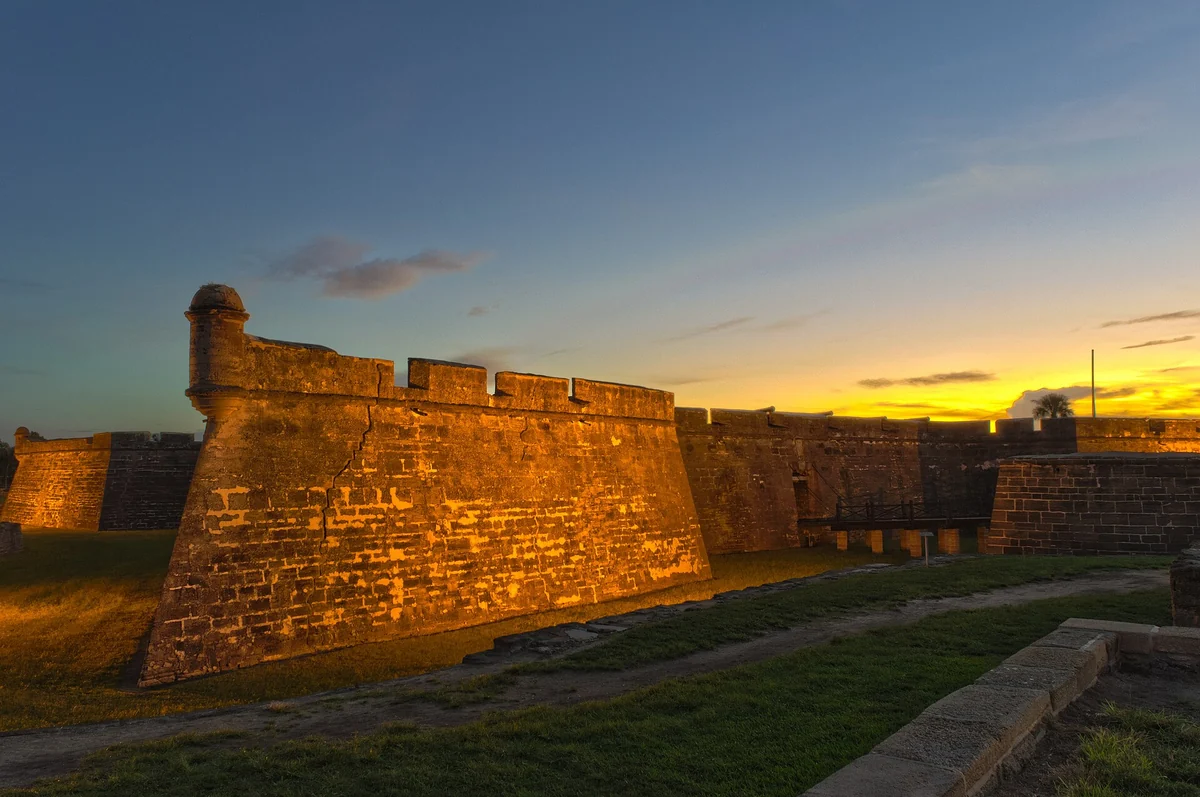
Castillo de San Marcos at daybreak. Photo: Kenneth Everett, CC BY-SA 3.0, via Wikimedia Commons
Quick answer Castillo de San Marcos at a glance
Castillo de San Marcos admission costs $15 per adult aged 16 and older on a pass valid 7 consecutive days, and children 15 and under enter free. The fort opens seven days a week except Thanksgiving Day and December 25, with first admission at 9:00 a.m. and last admission at 5:00 p.m. The National Park Service says the average visit lasts one to two hours. The fort sits at 1 South Castillo Drive on the bayfront, and its own lot charges $2.50 per hour for vehicles 21 feet or shorter.
Key takeaways
- Cannon and musket firings run five times on demonstration days, which sources put on Fridays to Sundays or most Saturdays and Sundays, and the times are listed in the tickets and hours section below.
- No car, no problem: the Waterfront Golf Cart Tour runs an open cart along the bayfront past the fort for $32 per person.
- The Hop-On Hop-Off Trolley loops the old city from $41 per person if you want to reach the fort without walking far.
- The rest of the old town, from St. George Street to the Plaza, is covered in the guide to things to do in St. Augustine.
Tickets, Hours and How Long to Stay
The Castillo is a National Park Service site with simple ticketing and a cashless gate. The figures below come from the National Park Service fee and hours pages.
Tickets, Passes and Hours
Admission is $15 per adult aged 16 and older on a Standard Pass valid 7 consecutive days, so one ticket covers repeat visits across a week. Children 15 and under enter free with an adult. The gate is cashless and takes credit and debit cards only. The park sells its own Annual Pass at $45, valid 12 months from the month of purchase and covering the holder plus three additional adults. America the Beautiful passes listed by the NPS are Resident Annual $80, Non-Resident Annual $250, Senior Annual $20 and Senior Lifetime $80, and Military, Access, 4th Grade and Volunteer passes are free. Holders of Interagency Access, Annual, Military and Senior passes enter free as stated on each card. The NPS also lists 2026 fee-free days on February 16, May 25, June 14, July 3 to 5, August 25, September 17, October 27 and November 11, when everyone enters free.
The fort is open seven days a week except Thanksgiving Day and December 25. First admission is at 9:00 a.m. and last admission at 5:00 p.m. Visitors must leave by 5:15 p.m., and the park grounds close from midnight to 6:00 a.m. The NPS says the average visitor spends one to two hours at the Castillo. The park phone number is 904-829-6506, and the NPS directs visitors to its calendar for current program times. There are no refunds when thunder and lightning close the upper level, though the lower rooms stay open.
Sources: NPS fees page and NPS hours page.
| Item | Detail | Source |
|---|---|---|
| Adult admission | $15, ages 16 and up, valid 7 consecutive days | NPS fees page |
| Children | Free, 15 and under with an adult | NPS fees page |
| Payment | Cashless, credit and debit only | NPS fees page |
| Park Annual Pass | $45, 12 months, holder plus 3 adults | NPS fees page |
| America the Beautiful | Resident Annual $80, Non-Resident Annual $250, Senior Annual $20, Senior Lifetime $80 | NPS fees page |
| Hours | First admission 9:00 a.m., last admission 5:00 p.m., off grounds by 5:15 p.m. | NPS hours page |
| Closed | Thanksgiving Day and December 25, grounds closed midnight to 6:00 a.m. | NPS hours page |
| Firing demonstrations | Five daily, NPS homepage says Fridays to Sundays, Visit St. Augustine says most Saturdays and Sundays | NPS and Visit St. Augustine |
| Fort lot parking | $2.50 per hour, vehicles 21 feet or shorter only | NPS fees page |
Firing Demonstrations and Ranger Programs
The weapon firings are the highlight for many visitors, and the sources differ on the schedule. The NPS homepage says cannon firing demonstrations take place five times a day on Fridays, Saturdays and Sundays. Visit St. Augustine lists firings from the gundeck on most Saturdays and Sundays throughout the year at 10:30 and 11:30 a.m. and 1:30, 2:30 and 3:30 p.m., weather and staffing permitting.
The NPS weapons page lists select demonstration dates at those same five times. The safest move is to check the NPS calendar for the day you plan to visit, since the fort typically fires cannons at some demonstrations and muskets at others depending on volunteers and staff. Visit St. Augustine notes that the NPS cancels firings during thunderstorms or extremely hot days, and that the cannons are visible from outside the walls but the narration can only be heard near the gundeck.
Demonstrations happen on the gundeck, reached only by the courtyard staircase, or can be watched from the seawall via a ramp. Ranger formal presentations usually run 15 to 20 minutes, informal stations let visitors handle cultural objects, rangers and volunteers in period dress pose for photos and tell colonial stories, and children can earn a Junior Ranger badge.
| Item | Detail | Source |
|---|---|---|
| Demonstration times | 10:30, 11:30 a.m., 1:30, 2:30 and 3:30 p.m. | NPS and Visit St. Augustine |
| Days | NPS homepage: Fri-Sun, Visit St. Augustine: most Sat-Sun, NPS weapons page: select dates | Both sources |
| Cancellations | Thunderstorms or extremely hot days | Visit St. Augustine |
What to See Inside and Accessibility
The NPS self-guided tour lists nine themed areas from the Sally Port to the Gundeck, and offers a park app for Android and iOS. The walls are massive: the NPS says the outer walls are 14 to 18 feet thick at the base and about 9 feet at the top, while another NPS history page gives an average of 12 feet with ocean-side walls reaching 19 feet. The fort holds four bastions named San Pedro, San Agustin, San Carlos and San Pablo, with a ravelin protecting the sally port. By 1740 the gun deck and city wall held over 60 cannons and the casemates could store as many as 20,000 cannonballs. The moat could be flooded with seawater to about one foot deep.
For accessibility, the NPS says the parking lot and the lower level are wheelchair accessible, and the lower level includes the fort rooms, theater, bookstore and restrooms. The gun deck can only be reached by stairs, though the outside viewing area has a ramp. Most walkways are paved, but those within the moat and covered way are sand and crushed shell stone. Rental wheelchairs are available from the City of St. Augustine Visitor Center at (904) 825-1000, and free parking is available in the handicapped space in the Castillo visitor lot for properly identified vehicles.
| Item | Detail | Source |
|---|---|---|
| Lower level | Wheelchair accessible: fort rooms, theater, bookstore, restrooms | NPS accessibility page |
| Gun deck | Stairs only, outside viewing area has a ramp | NPS and Visit St. Augustine |
| Walkways | Paved, but sand and crushed shell in the moat and covered way | NPS accessibility page |
| Wheelchair rental | City Visitor Center, (904) 825-1000 | NPS accessibility page |
Parking at the Fort
The lot in front of the Castillo is run by the park service and charges $2.50 per hour. It accepts only vehicles 21 feet or shorter, including trailers. Visit St. Augustine lists the paid hours as 10:00 a.m. to 9:00 p.m. daily in one article and 8:00 a.m. to 9:00 p.m. in another, so treat the earlier start as the safe assumption.
Larger vehicles can park free at West Castillo Drive and Riberia Street, about three blocks away, according to the NPS. Passengers may be dropped off and picked up in the Castillo lot, and a city parking garage reached from West Castillo Drive is a short walk away. The city's main garage is the Historic Downtown Parking Facility at 1 Cordova Street with 1,200 spaces, and the City lists $20 per vehicle per entry from 7 a.m. to 5 p.m. and $5 from 5 p.m. to 9 p.m., though a Visit St. Augustine guide calls the $20 a day rate.
If the fort lot is full, the St. Augustine parking guide lays out the other options. The full old town is covered in the guide to the St. Augustine historic district.
Sources: NPS Castillo fees, NPS hours, Visit St. Augustine cannon firing
Built of Coquina: The Fort's History
The Castillo is the only extant 17th-century military construction in the country and the oldest masonry fortress in the United States, according to the NPS. Spain began it in 1672, and the walls held through the 1702 and 1740 sieges.
Timeline of the Fort
The dates below come from the NPS history pages and Wikipedia's Castillo article. St. Augustine itself was founded on September 8, 1565 by the Spanish admiral Pedro Menendez de Aviles, before construction of the fort began in 1672. The engineer of the Castillo is named by Wikipedia as Ignacio Daza.
Where sources disagree, both readings are given, such as the length of the 1702 siege: the NPS says 51 days with over 1,500 people sheltering inside, while Wikipedia describes a two-month siege from November 1702.
| Year | Event |
|---|---|
| 1565 | Pedro Menendez de Aviles founds St. Augustine on September 8 |
| 1672 | Construction of the Castillo begins October 2, the core is finished in 1695 |
| 1702 | English forces under James Moore besiege the town, the NPS says over 1,500 people shelter in the fort for 51 days and a Spanish fleet from Havana ends the siege |
| 1740 | British forces under James Oglethorpe bombard the fort for 27 days before retreating |
| 1763 | Britain takes control and renames the fort Fort St. Mark, over 500 British soldiers are housed there during the 1763 to 1784 occupation |
| 1821 | The United States receives Florida and renames the fort Fort Marion, about 230 Seminole prisoners are held for two months in 1837, and Osceola is imprisoned after his October 1837 capture |
| 1875 | 74 Plains prisoners chosen from the Fort Sill reservation are imprisoned until 1878 under Richard Henry Pratt, among them 33 Cheyenne, 27 Kiowa, 11 Comanche, 2 Arapaho and 1 Caddo |
| 1886 | About 500 Apache men, women and children are held in 1886 to 1887 |
| 1924 | The Castillo is declared a National Monument on October 15, deactivated in 1933 after 251 years of military use and transferred to the National Park Service |
| 1942 | Congress restores the name Castillo de San Marcos |
Why Coquina Held
Coquina is a shell rock whose name is Spanish for small shells, and it is the reason the fort still stands. The Spanish quarried it on Anastasia Island in the area of present-day Anastasia State Park and cut over 400,000 coquina blocks, all set by hand. Oyster shells were burned into lime for the mortar and mixed with sand and water.
The rock's softness is its strength: the NPS says that in 1702 cannonballs bounced off or sank a few inches into the coquina, which compressed and absorbed the impact instead of shattering. Wikipedia puts it the same way, that the balls sank into the walls rather than puncturing them. Walls were raised during a 1738 to 1756 remodeling, and here the sources differ again: Wikipedia says walls went from 26 to 33 feet in the 1738 redesign, while the NPS self-guided tour page says they were about 28 feet in 1695 and rose to about 35 feet.
Either way, the 27-day bombardment of 1740 left the walls standing. The NPS says Fort Matanzas, 14 miles south, is the only other fortification in the world built of coquina. The fort drew 624,841 visitors in 2022.
Sources: NPS coquina history, NPS construction, Wikipedia
10 Things You Should Know Before Visiting Castillo de San Marcos
Practical points before a visit to the fort. Third-party video by ChadGallivanter. This site did not shoot it and has no relationship with the creator.
Around the Fort
The Castillo anchors the north end of the bayfront, and several sights sit within a short walk. Everything here is drawn from the facts on record.
The City Gate and the Cubo Line
The coquina pillars of the City Gate stand at the edge of the old walled city. They date to the 1808 reconstruction of the Cubo Line, which the Spanish first built in 1704, though Wikipedia's infobox for the Cubo Line says gates were rebuilt in coquina in 1763, so the two readings coexist. The line ran about half a mile from the Castillo to the San Sebastian River with a 40-foot moat and a nine-foot palm-log stockade.
Wikipedia says the two pillars were built in 1808 to support the wooden gate doors. Passing through them puts you on the streets covered in the St. George Street guide.
The Bayfront and the Bridge of Lions
The fort sits directly on the bayfront. The Bridge of Lions opened February 26, 1927 and reopened after rehabilitation on March 17, 2010. It is 1,545 feet long and 34 feet wide, a double-leaf steel bascule bridge carrying State Road A1A over the Matanzas River.
It is named for two Carrara marble Medici lion copies named Firm and Faithful, and two granite lions, Pax and Peli, were added in 2015. The bridge was added to the National Register of Historic Places on November 19, 1982. It opens on request on the hour and half-hour from 7:00 a.m. to 6:00 p.m., with no weekday openings at 8:00 a.m. or 5:00 p.m., per Visit St. Augustine, which also notes the 312 Bridge is sometimes easier between Anastasia Island and the mainland.
Walk-Up Carriages
Walk-up horse-drawn carriages operate in the historic district, and the city's rules and horse care facts are covered in the guide to St. Augustine carriage rides. No verified walk-up price for standard rides is available, so none is printed here. The private Carriage History Tour is bookable at $175 per carriage for 45 minutes, meeting at the corner of Cathedral Place and Charlotte Street, and the Carriage Ghost Tour matches it at $175 per carriage past Tolomato and Huguenot cemeteries.
Fort Matanzas
Fort Matanzas National Monument is the little sister of the Castillo, 14 miles south at 8635 A1A South, phone 904 471-0116. It was built of coquina from 1740 to 1742 under Governor Manuel de Montiano, is 50 feet wide and 30 feet high, and never fired its guns in anger again after beating off a British attempt on the inlet in 1742. It was designated a National Monument on October 15, 1924, the same day as the Castillo.
There is no fee to enter the park or to take the ferry to the fort. The park is open 9:00 a.m. to 5:30 p.m. daily except Thanksgiving Day and December 25, and ferries run Thursday through Monday at 9:30, 10:30 and 11:30 a.m. and 12:30, 1:30, 2:30 and 3:30 p.m., with no ferry service on Tuesdays and Wednesdays. Free ferry passes are issued in person at the Visitor Center, first come first served, valid only that day, and required for everyone including babies.
The NPS says it is not unusual for all passes to be gone before 11:00 a.m. The ferry carries 30 people and the tour runs roughly 45 minutes, boarding 5 minutes before the tour time. A 14-step staircase is the only entrance into the fort, and pets other than service animals, food and drink are not allowed on the boat or at the fort.
The lot has no space for buses or RVs.
Sources: NPS Fort Matanzas, Florida's Historic Coast City Gate, Wikipedia Bridge of Lions
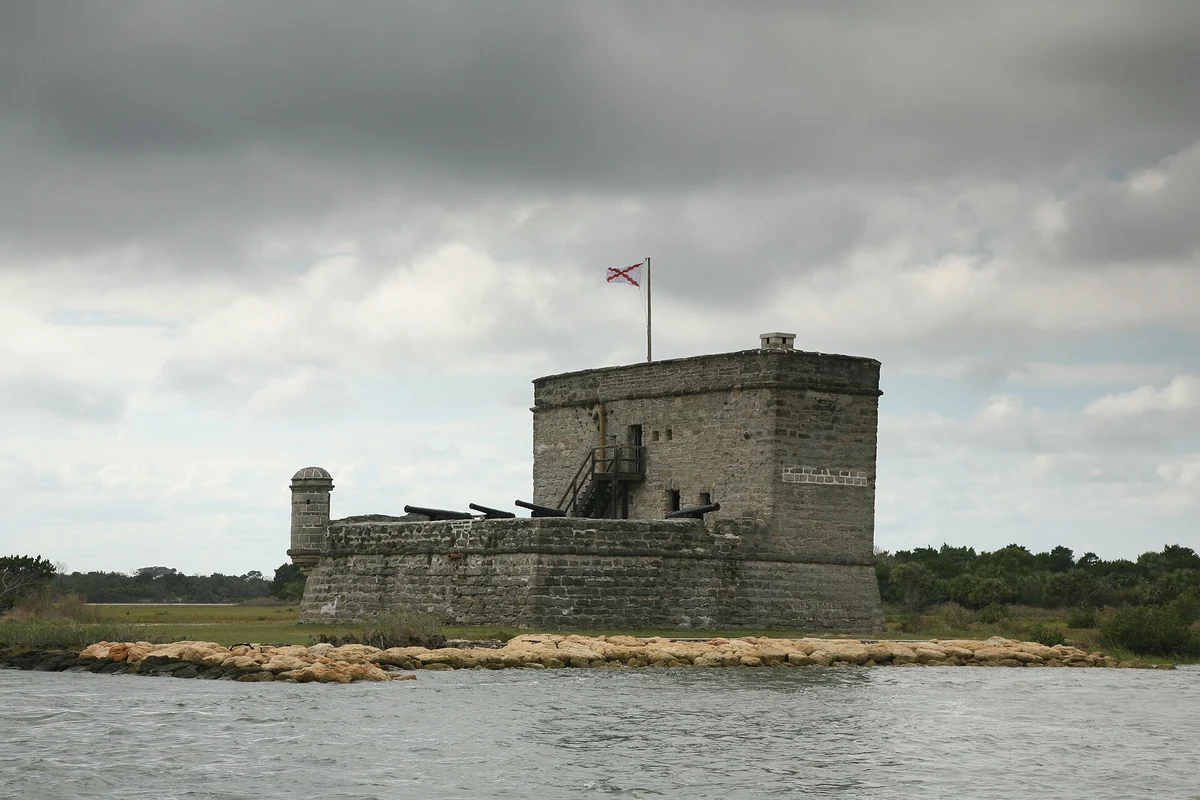
Fort Matanzas on the Matanzas River. Photo: Daniel Schwen, CC BY-SA 4.0, via Wikimedia Commons
Rides That Pass the Castillo
The fort stands on the bayfront, so the rides that work the waterfront go right past its walls. None of these rides includes entry to the Castillo. Admission is $15 per adult at the gate, and a ride is a way to see the outside and hear the story, not a substitute for the ticket.
Waterfront Golf Cart Tour
The Waterfront Golf Cart Tour costs $32 per person for 1 hour in an open electric golf cart run by St Augustine Land and Sea Tours. It runs from the Plaza de la Constitución to the bayfront and Mission Nombre de Dios, which puts the Castillo walls in view along the water. A certified guide drives, photos are included, and free cancellation applies 24 hours ahead.
Food, drinks and gratuities are not included, and the meeting point is 150 Charlotte St.
Historical Tour, Free Parking
The Historical Tour, Free Parking by Pineapple Ride & Tour costs $48 per person for a narrated hour in an open-sided electric vehicle for up to 10. It starts at 134 Riberia Street at San Sebastian Marina, on Riberia Street, the same street as the fort's free overflow parking at West Castillo Drive, and the ticket includes all-day free parking at the marina. All ages ride, infants on an adult's lap, and free cancellation applies 24 hours ahead.
Hop-On Hop-Off Trolley
The Hop-On Hop-Off Trolley costs $41 per person for a 1 or 2-day ticket on the Old Town Trolley, with 22 stops, the History Museum included, and loops every 15 to 20 minutes. The full loop takes 90 minutes and the boarding point is 167 San Marco Ave, where the Old Jail offers free onsite parking for visitors. It is the ride to pick if you want to hop off near the fort, walk the walls for an hour or two, and hop back on.
Hotel pickup, food, drinks and tips are not included.
Tips for Visiting the Castillo
Do
- Do buy your ticket with a card, because the NPS gate is cashless and takes credit and debit only.
- Do time your visit to a firing demonstration at 10:30, 11:30 a.m., 1:30, 2:30 or 3:30 p.m., but confirm the day on the NPS calendar because schedules vary by volunteers and staff.
- Do keep your ticket, because the Standard Pass is valid 7 consecutive days and a second visit costs nothing.
- Do bring the whole family, since children 15 and under enter free with an adult and a Junior Ranger badge is offered.
- Do plan for one to two hours, the average visit length given by the NPS, and add time if a ranger presentation of 15 to 20 minutes is on.
Don't
- Don't expect a refund if a storm closes the upper level, because the NPS states there are no refunds when thunder and lightning shut the gundeck, though the lower rooms stay open.
- Don't bring an oversized vehicle to the fort lot, because it charges $2.50 per hour and accepts only vehicles 21 feet or shorter including trailers, and larger vehicles park free about three blocks away.
- Don't count on seeing the gundeck in a wheelchair, because it is reachable only by stairs, though the lower level and the seawall viewing ramp are accessible.
- Don't drive to Fort Matanzas on a Tuesday or Wednesday expecting the ferry, because there is no ferry service those days and free passes can run out before 11:00 a.m.
Castillo de San Marcos FAQ
What is the oldest fort in America?
The Castillo de San Marcos in St. Augustine is described by the National Park Service as the oldest masonry fort in the continental United States and the only extant 17th-century military construction in the country. Construction began October 2, 1672 and the core was finished in 1695. You can pair it with nearby Fort Matanzas, covered in the Around the Fort section.
How much are Castillo de San Marcos tickets?
Admission is $15 per adult aged 16 and older on a pass valid 7 consecutive days, and children 15 and under enter free. The NPS lists a $45 park Annual Pass and fee-free days. The full table of passes is in the tickets section.
What are the Castillo de San Marcos hours?
The fort opens seven days a week except Thanksgiving Day and December 25, with first admission at 9:00 a.m. and last admission at 5:00 p.m., and everyone must leave by 5:15 p.m. Grounds close from midnight to 6:00 a.m. Firing demonstration times are listed in the hours and demonstrations table.
Is Castillo de San Marcos wheelchair accessible?
Partly. The NPS says the parking lot and lower level, including the fort rooms, theater, bookstore and restrooms, are wheelchair accessible, and the seawall viewing area has a ramp, but the gun deck is reachable only by stairs. Details are in the accessibility block.
Where do I park for the Castillo de San Marcos?
The park-run lot in front of the fort charges $2.50 per hour and takes only vehicles 21 feet or shorter. Larger vehicles can park free at West Castillo Drive and Riberia Street about three blocks away, and a city parking garage reached from West Castillo Drive is a short walk. More options are in the St. Augustine parking guide.
Can I see the Castillo without buying a ticket?
Yes, from outside. Visit St. Augustine notes the cannons can be seen from outside the walls during a firing, and the rides that work the bayfront pass the fort, like the Waterfront Golf Cart Tour at $32 per person and the Hop-On Hop-Off Trolley from $41 per person. Interior rooms and the gundeck need the $15 admission.