 St. Augustine Carriage Tours
The St. Augustine Historic District
The St. Augustine historic district holds the oldest continuously inhabited European-established settlement in the contiguous United States, founded in 1565. This guide covers what the district is, the four centuries of Spanish, British and Flagler-era buildings inside it, the streets and houses worth your time, and the ways to see it: on foot, by horse-drawn carriage, by golf cart or on the Old Town Trolley. Bookable rides are compared with exact prices. Attraction tickets and walk-up carriage fares appear only as attributed information. For the full ride comparison, see the St. Augustine carriage tours page. The bookable rides are compared on St. Augustine carriage rides.
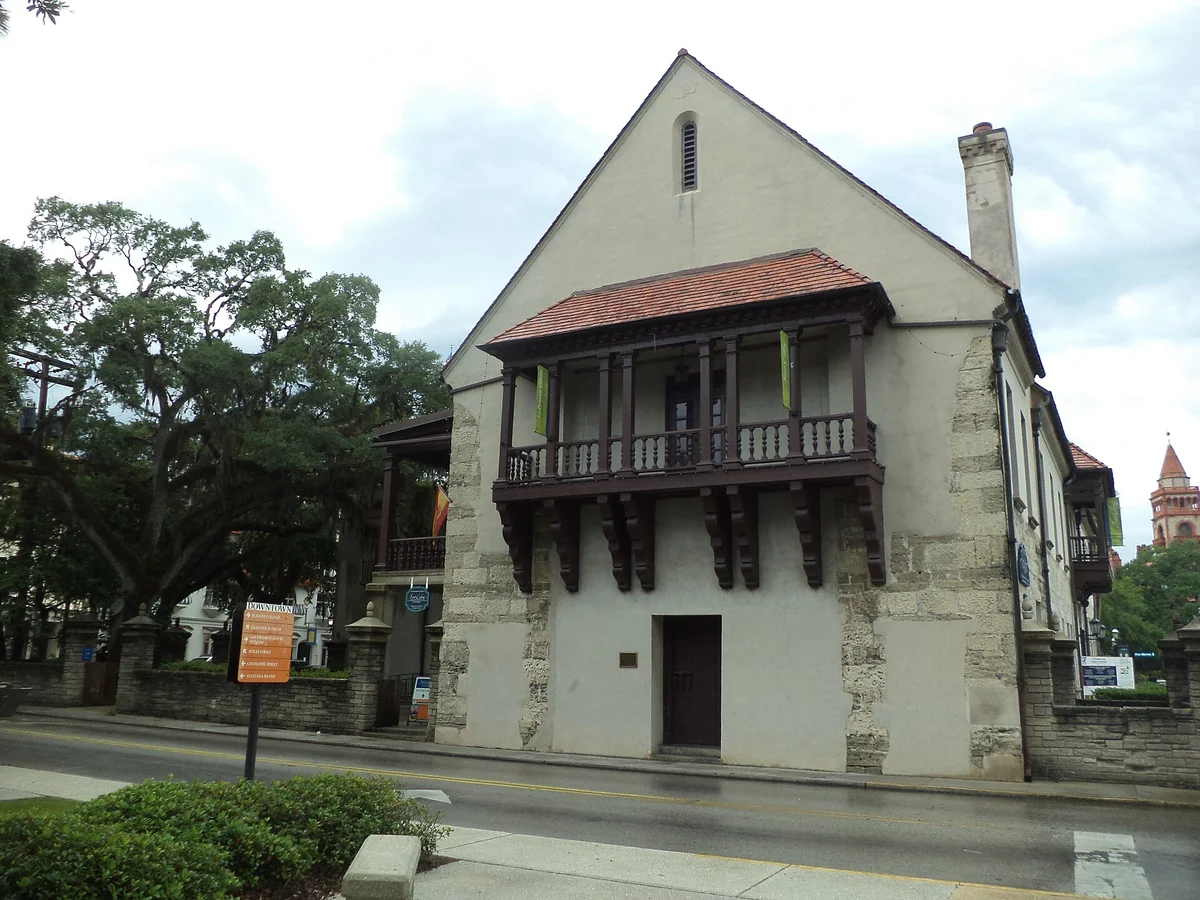
Government House on the Plaza. Photo: Michael Rivera, CC BY-SA 3.0, via Wikimedia Commons
Quick answer The district at a glance
The St. Augustine historic district is the 113-acre St. Augustine Town Plan Historic District, listed on the National Register on April 15, 1970. It is bounded by Cordova, Orange and St. Francis Streets and Matanzas Bay. Inside it sit the Plaza de la Constitución, the Cathedral Basilica, the City Gate and blocks of Spanish Colonial and Moorish Revival buildings. Roughly half its buildings predate 1925.
Key takeaways
- The Spanish laid out the Plaza in 1573 under Royal Ordinances and the street plan still follows it. See the era-by-era table for dates and landmarks.
- The easiest sit-down way to cover the streets is the private electric cart tour, 90 minutes for up to 7 people at $200 per cart.
- On foot, start at Aviles Street, called the oldest street in the nation, and the Oldest House at 14 St. Francis Street. More ideas are on the things to do page.
- Carriages, carts and trolleys each cover different ground. Compare them on the homepage comparison table.
What the Historic District Is
The district is a formal National Historic Landmark District, not a marketing name for downtown.
The Town Plan District
The St. Augustine Town Plan Historic District was added to the National Register and designated a National Historic Landmark District on April 15, 1970, under reference 70000847. Wikipedia gives its area as 113 acres and its boundaries as Cordova Street, Orange Street, St. Francis Street and Matanzas Bay. A second description in the same article says roughly Grove Avenue, the Matanzas River, South Street and Washington Street. The boundaries were not formally defined until 1986. Visitors should treat the first set as the working map.
Roughly half the buildings in the district predate 1925. Many are Spanish Colonial or Moorish Revival in style, a legacy of the building booms described below. People searching for historic downtown St. Augustine or old town St. Augustine usually mean this same ground.
The Colonial Walled City
St. Augustine was founded on September 8, 1565 by the Spanish admiral Pedro Menendez de Aviles. The Spanish defended the town twice over: from the sea by the Castillo de San Marcos, begun October 2, 1672 and completed in 1695, and from the land side by the Cubo Line, first built in 1704. The Cubo Line ran about half a mile from the Castillo to the San Sebastian River behind a 40-foot moat and a nine-foot palm-log stockade. The coquina pillars of the City Gate that still stand on St. George Street date to the 1808 reconstruction of that line, though the same Wikipedia article's infobox says the gates were rebuilt in coquina in 1763, so sources give two dates.
The town inside the line was laid out on the 1573 Spanish plan centered on the Plaza de la Constitución. The Castillo is covered in full on the Castillo de San Marcos page.
Sources: Wikipedia, St. Augustine Town Plan Historic District, Florida's Historic Coast
Four Centuries in a Few Blocks
The district compresses five political eras into a few walkable blocks, and each left a mark you can still see.
The Eras at a Glance
The table pulls the five periods together with a landmark for each. The years for the British and second Spanish periods come from Wikipedia's account of the district. The Spanish era runs from the 1565 founding, the American era from the 1822 annexation of Florida by the United States, and the Flagler era from the hotel openings of 1887 and 1888.
| Era | Years | Landmarks |
|---|---|---|
| First Spanish | 1565-1763 | Plaza de la Constitución (1573), Cathedral Basilica parish (1565), Government House site (1598), Castillo de San Marcos (1672-1695), City Gate (1704 line, 1808 pillars) |
| British | 1763-1784 | Over 500 British soldiers housed in the Castillo, renamed Fort St. Mark |
| Second Spanish | 1784-1822 | Cathedral building (1793-1797), Gonzalez-Alvarez House expansions (1775 to 1786 and 1790), City Gate pillars (1808), Constitution Monument (1813) |
| American | 1822-1880s | Fort renamed Fort Marion in 1821, Lincolnville founded 1866 |
| Flagler era | 1887 onward | Hotel Ponce de Leon (1888), Hotel Alcazar (1887), Casa Monica (1888) |
Spanish Era
Spain founded the town in 1565. The Cathedral Basilica parish dates to 1565 and is described as the oldest Christian congregation in the contiguous United States. The Plaza de la Constitución was laid out in 1573 under Spanish Royal Ordinances.
Governor Gonzalo Mendez de Canzo built his residence on the Government House site in 1598, with a new building going up in 1706. The Castillo de San Marcos, begun in 1672 of more than 400,000 hand-cut coquina blocks, absorbed two sieges: in 1702 the NPS says over 1,500 people sheltered inside for 51 days, while Wikipedia describes a two-month siege, and a third account gives a 58-day siege, so the sources differ on the length but agree on the outcome. In 1740 British forces under James Oglethorpe bombarded the fort for 27 days and retreated.
British and Second Spanish Eras
Britain held Florida from 1763 to 1784 and renamed the fort Fort St. Mark, housing over 500 British soldiers in the Castillo during the occupation. From 1784 to 1822 the town rebuilt: the present Cathedral Basilica was constructed 1793-1797, the Gonzalez-Alvarez House took its later expansions between 1775-1786 and 1790, the City Gate pillars went up in 1808 and the Plaza's Constitution Monument obelisk was built in 1813, believed to be the only surviving monument of its kind. The United States received the fort in 1821 and renamed it Fort Marion, and annexed Florida in 1822.
Congress restored the name Castillo de San Marcos in 1942.
Flagler Era
Henry Flagler built the Hotel Ponce de Leon, which opened January 10, 1888 with 540 guest rooms, designed by Carrere and Hastings and now a National Historic Landmark occupied by Flagler College, founded in 1968. Historic tours of the college last about 45 to 60 minutes and the Dining Hall holds one of the largest collections of Louis Comfort Tiffany stained glass windows in the world. The same architects completed the Hotel Alcazar in 1887, now the Lightner Museum, bought by Chicago publisher Otto Lightner on August 20, 1947 and opened as a museum in 1948.
Its indoor pool was then the world's largest and is now drained, with Cafe Alcazar on the pool floor. Franklin W. Smith opened the Casa Monica in 1888 and sold it to Flagler for $325,000, who renamed it the Cordova Hotel. It served as the county courthouse before reopening as a hotel in December 1999 and joining Marriott's Autograph Collection in 2010.
Sources: Wikipedia, NPS, Flagler College
St. Augustine, Florida Walking Tour (Historic Downtown)
A walk through the historic downtown streets. Third-party video by City Wander. This site did not shoot it and has no relationship with the creator.
Streets and Houses to Know
Six places carry most of the district's story, from the 16th century to the civil rights movement of 1964.
Aviles Street
Florida's Historic Coast calls Aviles Street the oldest street in the nation, dating to the 16th century. The Ximenez-Fatio House stands at 20 Aviles Street. Wikipedia says Andres Ximenez bought that property in 1797 and the house was built between 1797 and 1802.
Its own published prices are $15 for the guided tour for ages 12 and up, $12 for the audio tour, $10 for seniors, students and military, $6 for children 7 to 12 and $5 for St. Johns County residents. Those are the house's own admission figures, given as information.
The Oldest House
The Gonzalez-Alvarez House, marketed as the Oldest House, is the district's anchor domestic building. Wikipedia gives its construction as circa 1723 with later work in 1775 to 1786 and 1790, and it was added to the National Register on April 15, 1970 under reference 70000845. The St. Augustine Historical Society operates it, and it has been open to visitors since 1893.
The Oldest House Museum complex at 14 St. Francis Street is open daily 10:00 a.m. to 5:00 p.m. with guided tours every half hour, phone (904) 824-2872. Visit St. Augustine lists admission at $12.95 for adults, $9.95 for seniors 55 and over and military with ID, $4.95 for students and children 4 to 17, under 4 free, and a family ticket at $25.95. County residents with ID pay half price.
The complex includes two museums, a colonial kitchen, an ornamental garden and the St. Augustine Surf Culture and History Museum. All of these are Visit St. Augustine figures, not tickets sold here.
Government House and the Plaza
Government House faces the Plaza at the corner of King and St. George Streets. The site dates to Governor de Canzo's residence of 1598 and a rebuilding of 1706. Florida received the building in February 1966 and its ground floor is now the free Governor's House Cultural Center and Museum, at 48 King Street, phone 904-825-5034, open daily 10 a.m. to 5 p.m.
The Plaza de la Constitución itself was designated a National Historic Landmark in 1970, and its 1813 obelisk stands at its center. The gazebo hosts Concerts in the Plaza on Thursday evenings from June through August. The Cathedral Basilica, built 1793-1797 and rebuilt by architect James Renwick Jr. after the fire of April 12, 1887.
It became a cathedral in 1870 and a minor basilica in 1976.
Lincolnville and 1964
Visit St. Augustine says freed people founded Lincolnville in 1866 and that it covers a 50-block region south of King Street. About 672 people in St. Augustine were freed from slavery on January 1, 1863, per the Florida State Archives as quoted by Visit St. Augustine. The city's first public school for Black students opened there in 1901, and Lincolnville joined the National Register in 1991. The Lincolnville Museum and Cultural Center at 102 M. L. King Avenue charges $10 for adults, $9 for seniors 60 and over and military, and $5 for youth 7 to 17 and college students, per the museum's own site. Its hours are Tuesday to Saturday 10:30 a.m. to 4:30 p.m. and Sunday and Monday 1:00 p.m. to 4:30 p.m., phone (904) 824-1191.
The 1964 civil rights movement belongs to the district's story. Wikipedia dates the St. Augustine movement to 1963 and 1964, and says Dr. Martin Luther King Jr. was arrested on the steps of the Monson Motor Lodge restaurant on June 11, 1964. On June 18, 1964, 17 rabbis were arrested at the Monson motel, the largest mass arrest of rabbis in US history. The ACCORD Freedom Trail trolley tour, led by historian David Nolan, lasts about 2 hours, suggests a $25 donation and meets at the Willie Galimore Center, 399 S. Riberia Street, per Visit St. Augustine. That figure is the tour's own suggested donation, not a bookable ride on this site.
The City Gate and the School House
The City Gate coquina pillars mark the old land entrance to the walled town on St. George Street, the street this site covers separately on the St. George Street page. Wikipedia's Cubo Line article says two coquina pillars were built in 1808 to support the wooden gate doors, while the same article's infobox says the gates were rebuilt in coquina in 1763, so both dates are reported. Near the gate, at 14 St. George Street, stands the Oldest Wooden School House, which first appears on tax records in 1716 and was not used as a school until 1788.
Its walls are bald cypress and red cedar held by wooden pins and iron spikes, and a chain placed in 1937 anchors the building against hurricanes. Wikipedia's infobox gives a date of circa 1702, against the 1716 tax-record date, another source split worth knowing before you go.
Sources: Visit St. Augustine, Wikipedia, Lincolnville Museum
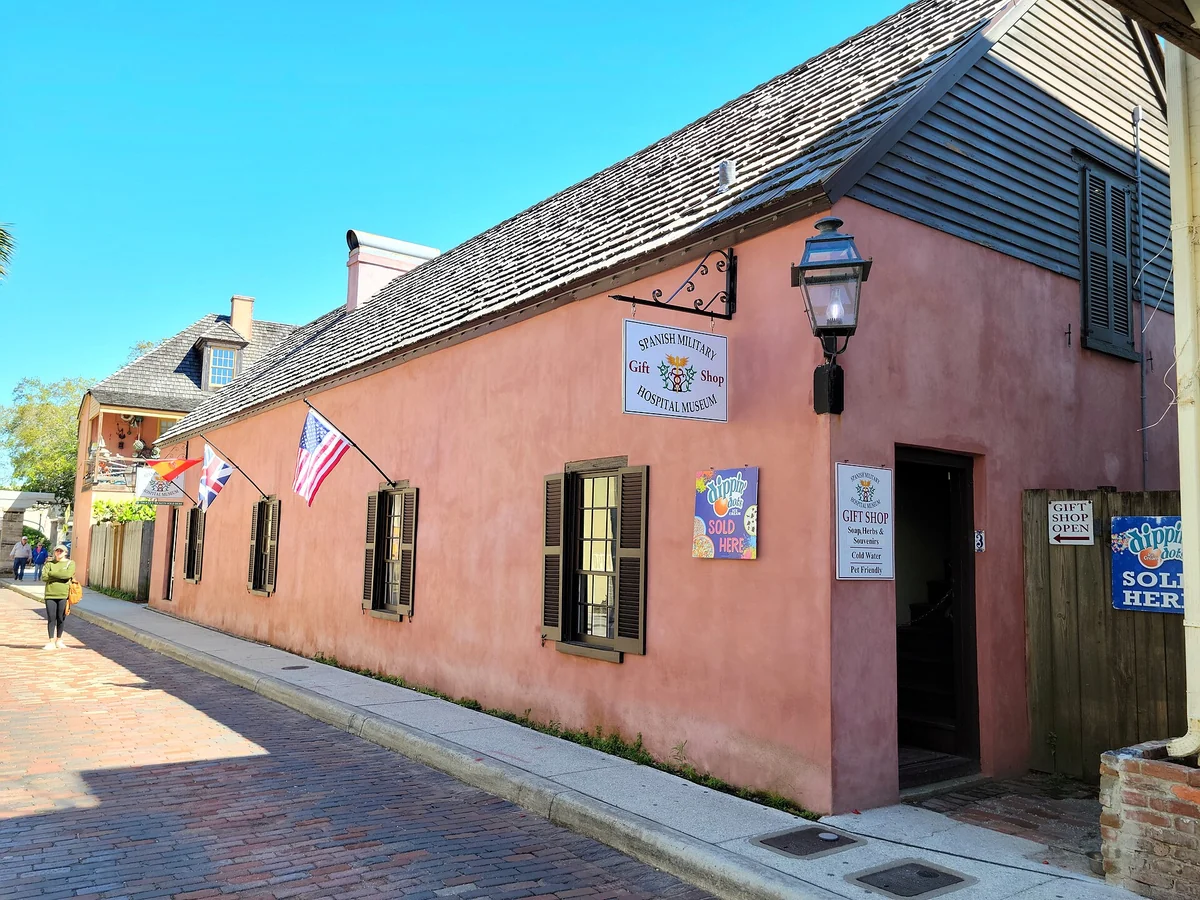
The Spanish Military Hospital Museum on Aviles Street. Photo: Kiran891, CC BY-SA 4.0, via Wikimedia Commons
Seeing the District by Carriage, Cart or Trolley
The same 113 acres can be covered four ways, and the price and the format differ sharply between them.
Horse-drawn Carriage
Carriages are the classic way to see the historic district and the only horse-drawn option. Two private rides appear on this site's cards. The carriage history tour runs 45 minutes at $175 per carriage, private, with a live guide blending history and family-friendly ghost tales, departing from the corner of Cathedral Place and Charlotte Street. The carriage ghost tour covers the same format and price at $175 per private carriage for 45 minutes, riding past Tolomato and Huguenot cemeteries, with entry to the cemeteries and Flagler College not included. Both are family-friendly and both include free cancellation 24 hours ahead.
The carriage rides in St. Augustine section of the homepage explains where the walk-up carriages wait, but the walk-up fares themselves are the operators' own prices and appear only as attributed information, not as bookable rates.
Golf Cart and Electric Cart
The shared options are the waterfront golf cart tour at $32 per person for 1 hour, departing from 150 Charlotte Street by the Plaza, and the guided golf cart tour at $45 per person for 1 hour, up to 9 per cart, from the Downtown Historic Parking Facility at 1 Cordova Street. The one-hour historical cart tour at $48 per person runs in an open-sided electric vehicle for up to 10, with all-day free parking at the marina at 134 Riberia Street. For privacy, the private electric cart tour takes up to 7 people for 90 minutes at $200 per cart, the most reviewed ride on this site.
Old Town Trolley
The trolley trades intimacy for coverage. The hop-on hop-off trolley ticket costs $41 per person for 1 or 2 days, covering 22 stops with the History Museum included, and a full loop takes 90 minutes with departures every 15 to 20 minutes from 167 San Marco Avenue. You get on and off at the Plaza, the Castillo and the other district landmarks and set your own pace, which no carriage or cart allows.
In the holiday season the same open-air trolleys run the Nights of Lights: the Nights of Lights trolley ride costs $81 per private row of up to 4 for a 40-minute caroling ride with cider and cookies, and the Nights of Lights electric cart costs $42 per person for 45 minutes. Both are seasonal and covered in depth on the Nights of Lights page.
Which Format Fits
A carriage suits couples and small parties who want the slow, horse-drawn pace and a private guide for $175 for the whole group. A shared cart suits one or two travelers watching cost, at $32 to $48 per person. The private cart at $200 per cart works for families up to 7.
The trolley at $41 per person suits anyone planning a full day inside and outside the district, since the 22 stops reach beyond the 113 acres.
Sources: operator listings
Dos and Don'ts in the District
Practical points drawn from the official sources above.
Do
- Do start at the Plaza de la Constitución, because the 1573 Spanish plan centers everything there and the Government House museum at 48 King Street is free and open daily 10 a.m. to 5 p.m.
- Do time the Oldest House for the half-hourly guided tours, because Visit St. Augustine lists hours of 10:00 a.m. to 5:00 p.m. daily and lists an adult ticket at $12.95.
- Do book a ride in advance if the format matters to you, because the private carriage at $175 per carriage and the private cart at $200 per cart both offer free cancellation 24 hours ahead.
- Do visit Lincolnville, because the Lincolnville Museum at 102 M. L. King Avenue charges $10 for adults and its 50-block district carries the story of 1866.
- Do catch a Thursday evening concert in the Plaza gazebo if you visit between June and August, because Concerts in the Plaza runs weekly all summer.
Don't
- Don't assume a $15 Castillo entry covers anything else, because the National Park Service sets that fee separately for adults 16 and older, valid 7 days.
- Don't expect entry to the cemeteries or Flagler College on the carriage ghost tour, because its listing states they are not included.
- Don't park a vehicle over 21 feet in the Castillo lot, because the city lot there charges $2.50 per hour and accepts only vehicles 21 feet or shorter, including trailers.
- Don't plan to see the whole 113-acre district by car, because St. George Street is pedestrian-only and the ride formats compared here are carriages, carts, trolleys and your own feet.
Where to Stay Near the Historic District
Each link opens the live room list for that area on the booking site, with today's prices.
Historic downtown
- Suits
- Staying inside the old town
The walk-up carriages wait on the bayfront across from Meehan's Irish Pub, and the downtown garage at 1 Cordova Street charges $20 per entry by day, per the city.
See stays in Historic downtownSt. Augustine Beach
- Suits
- A beach stay on Anastasia Island
The Bridge of Lions carries State Road A1A from the old town over the Matanzas River to Anastasia Island.
See stays in St. Augustine BeachFrequently Asked Questions
What exactly is the St. Augustine historic district?
It is the St. Augustine Town Plan Historic District, a National Historic Landmark District listed on April 15, 1970, covering 113 acres bounded by Cordova, Orange and St. Francis Streets and Matanzas Bay. The full boundaries and the colonial walled city are described in the what the district is section.
What is the oldest building to visit in the district?
The Gonzalez-Alvarez House, the Oldest House at 14 St. Francis Street, has construction dates from circa 1723 with tours every half hour daily from 10:00 a.m. to 5:00 p.m. Admission figures and hours come from Visit St. Augustine.
Can you see the historic district by carriage?
Yes. The private carriage history tour runs 45 minutes through the district at $175 per carriage, and a ghost-themed ride on the same format is also available.
What is the cheapest way to tour the district with a guide?
The shared waterfront golf cart tour costs $32 per person for 1 hour and starts at 150 Charlotte Street by the Plaza, which is the lowest per-person price among the guided rides compared here.
Where did the civil rights movement happen in St. Augustine?
Around St. Augustine: Dr. Martin Luther King Jr. was arrested at the Monson Motor Lodge on June 11, 1964, and Lincolnville, founded in 1866, holds the Lincolnville Museum at 102 M. L. King Avenue. The Lincolnville and 1964 section covers the sites.
Is the trolley good for seeing the historic district?
It is the broadest option: the hop-on hop-off trolley costs $41 per person for 1 or 2 days across 22 stops with a 90-minute full loop, so you can hop off at the Plaza and the other district landmarks and reboard at will.