 St. Augustine Carriage Tours
St. George Street, St. Augustine: What to See, Hours and Parking
St. George Street is the pedestrian spine of St. Augustine, running from the City Gate down to the Plaza de la Constitución on a colonial roadbed first laid out in the 1700s. This guide covers the street's Spanish layout, what stands on it today with sourced prices and hours, when to go, where to park, and the carriage and cart rides that travel the streets around it. Prices for the museums come from Visit St. Augustine and Florida's Historic Coast. Prices for bookable rides come from the comparison cards on this site only. For the wider old town, see the guide to the St. Augustine historic district. The bookable rides are compared on St. Augustine carriage tours compared.
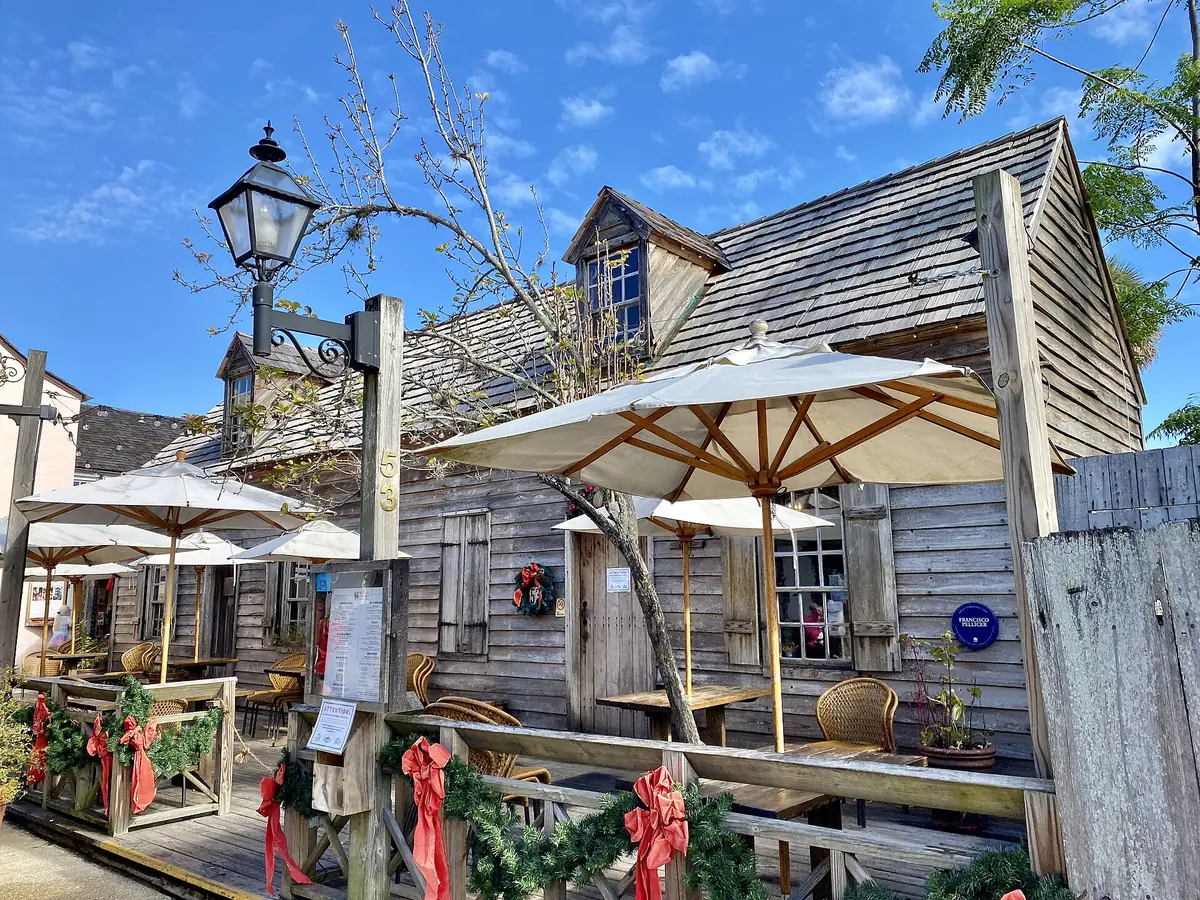
The reconstructed Pellicer-De Burgo House on St. George Street. Photo: w_lemay, CC BY-SA 2.0, via Wikimedia Commons
Quick answer St. George Street at a glance
St. George Street in St. Augustine is a pedestrian-only street on a colonial roadbed first laid out in the 1700s, running from the City Gate to the Plaza de la Constitución. It was founded as a city in 1565, making St. Augustine the oldest continuously inhabited European-established settlement in the contiguous United States. You cannot drive it, so the closest parking is the city garage at 1 Cordova Street with 1,200 spaces. The street itself is free to walk, and the museums on it charge from $6.95 per adult at the Oldest Wooden School House to $15.99 per adult at the Colonial Quarter, per Visit St. Augustine and Florida's Historic Coast.
Key takeaways
- The street is pedestrian-only, per Visit St. Augustine, so park once and walk. See the parking and meeting point guide for where each ride starts.
- A private carriage history tour costs $175 per carriage and is a 45-minute ride through the historic districts.
- Budget travellers can take a waterfront golf cart tour at $32 per person for one hour from the Plaza.
- Compare every ride on the homepage comparison table before you choose.
The Street From the City Gate to the Plaza
St. George Street follows the colonial roadbed of a city planned by Spain more than four centuries ago. Its two fixed points are the City Gate at the north end and the Plaza de la Constitución at the south.
A Spanish Grid From 1573
Spanish admiral Pedro Menendez de Aviles founded St. Augustine on September 8, 1565. The town that grew around that landing still follows a plan laid out in 1573 under Spanish Royal Ordinances. The Plaza de la Constitución dates to that layout, and it was designated a National Historic Landmark in 1970.
St. George Street runs through the middle of this layout, from the City Gate at the north down to the Plaza at the south. Visit St. Augustine describes the street today as a pedestrian-only route through Historic Downtown that follows this colonial roadbed from the 1700s. The wider district around it covers 113 acres and was added to the National Register as the St. Augustine Town Plan Historic District on April 15, 1970, under reference 70000847.
You can read more about the surrounding blocks in the guide to the St. Augustine historic district.
The Name and the British Years
The street has carried its name since the British period. Spain ceded Florida to Britain under the 1763 Treaty of Paris, and St. Augustine became the capital of British East Florida. The British held Florida from 1763 to 1784, and a Florida Fiction archive entry records that the British renamed the street George Street during the 1763 to 1783 years.
Before that, first-period streets were generally unnamed, though one Calle Real was maintained from the Treasury. Spain took Florida back in 1784, and the Second Spanish Period ran until 1822, when the United States annexed Florida. The name outlasted both changes of flag.
The City Gate
The two coquina pillars at the north end of St. George Street are the City Gate, what remains of the Cubo Line defences. The Spanish first built the Cubo Line in 1704 as a barrier across the peninsula. The line ran about half a mile from the Castillo de San Marcos to the San Sebastian River, with a 40-foot moat and a nine-foot palm-log stockade.
Wikipedia records that the coquina pillars standing today were built in 1808 to support the wooden gate doors, though the same article's infobox gives a 1763 coquina rebuild, so the two accounts differ on the date. Either way, the pillars have watched over the north end of the street for more than two centuries.
Pedestrian Status and Street Life
Visit St. Augustine lists St. George Street as a pedestrian-only route, so cars do not drive it. That is why the horse-drawn carriages, golf carts and trolleys on this site travel the streets that frame it rather than the street itself. One quirk worth knowing before you go: Visit St. Augustine notes that street performers are not permitted on St. George Street, so the entertainment comes from the venues instead.
The Colonial Oak Music Park hosts live music on the street, and its restroom at 42 1/2 St. George Street is open from 10:00 a.m. until it closes, at least 9:00 p.m., according to the city. At the south end, the Plaza gazebo hosts Concerts in the Plaza on Thursday evenings from June through August, a way to end a walk down the street.
Sources: Visit St. Augustine, Florida's Historic Coast, Wikipedia
What Is on St. George Street
The street packs several historic sites into a short walk, most of them ticketed and most of them cheap. The table below compares the main places on and beside the street, with prices and hours as published by Visit St. Augustine, Florida's Historic Coast and the sites themselves.
The Main Stops Compared
Figures come from the sources named in the table, which are the operators' own listings and the two official tourism bodies. Where a source publishes no price, the table says not stated.
| Place | What it is | Price | Source |
|---|---|---|---|
| Oldest Wooden School House, 14 St. George Street | Wooden schoolhouse first on tax records in 1716, a school from 1788 | $6.95 adults, $5.95 ages 6 to 12, 5 and under free | Visit St. Augustine |
| Colonial Quarter | Living history campus with a 35-foot watchtower | $15.99 adults, $12.99 seniors 55+ and military, $9.99 children 5 to 12 | Florida's Historic Coast |
| Spanish Military Hospital Museum, 3 Aviles Street | Reconstruction of a Second Spanish Period hospital depicting 1791 | Not stated | Visit St. Augustine |
| Governor's House Cultural Center and Museum, 48 King Street | Museum facing the Plaza at King and St. George | Free | University of Florida |
| Peña-Peck House | Historic house museum with guided tours | Not stated, tours temporarily closed per its site | Peña-Peck House |
| Colonial Oak Music Park | Live music venue on the street | Not stated | Visit St. Augustine |
Oldest Wooden School House
The Oldest Wooden School House stands at 14 St. George Street, right by the City Gate. It first appears on tax records in 1716, though the Wikipedia infobox gives a construction date of about 1702, so the two accounts differ by fourteen years. It did not serve as a school until 1788, when Juan Genoply added a second story and made it a co-ed school.
The walls are bald cypress and red cedar held together with wooden pins and iron spikes. A chain placed in 1937 anchors the building against hurricanes. Admission is $6.95 for adults and $5.95 for students ages 6 to 12, with children 5 and under free, per Visit St. Augustine.
Hours are Monday to Thursday 10:00 a.m. to 5:00 p.m., Friday and Saturday 10:00 a.m. to 7:00 p.m., and Sunday 10:00 a.m. to 5:00 p.m. The contact number is 904-824-0192.
The Colonial Quarter
The Colonial Quarter is a living history campus on the street with a 35-foot watchtower. Florida's Historic Coast offers the Colonial Quarter experience daily from 10 a.m. to 5 p.m., with guided tours at 10:30 a.m., noon, 1:30 and 3 p.m. Admission is $15.99 for adults, $12.99 for seniors 55 and over and military with ID, and $9.99 for children 5 to 12, per Florida's Historic Coast.
The Colonial Quarter's own website lists ticket sales at 14 S Castillo Drive with hours of 10 a.m. to 5 p.m. and no price, while Florida's Historic Coast gives the address as 29 Old Mission Ave with phone (904) 829-1711. The two sources disagree on the address, so check both before you set out. The group sales phone is 904-599-2113.
Spanish Military Hospital Museum
At 3 Aviles Street, the Spanish Military Hospital Museum reconstructs a military hospital from the Second Spanish Period, which ran from 1784 to 1821, and depicts life in the year 1791. The visit is a 40-minute fully guided tour that includes a demonstration of colonial surgery techniques, which visitors either love or wince through. Visit St. Augustine lists it as open daily from 9:00 a.m. to 5:00 p.m. with phone (904) 342-7730.
The listing publishes no admission price, and third-party figures were not confirmed on an official page, so the price here is not stated. Aviles Street also holds the Ximenez-Fatio House at number 20.
Governor's House and the Peña-Peck House
Two more places are worth knowing. The Governor's House Cultural Center and Museum sits at 48 King Street, facing the Plaza at the corner of King and St. George Streets. It is free to enter, open daily from 10 a.m. to 5 p.m., with phone 904-825-5034, per the University of Florida.
The Peña-Peck House lists tour hours of 12:00 p.m. to 4:30 p.m. with the last tour at 3:15 p.m. Its own site notes a temporary closure for tours after an air conditioning failure, with no reopening date given, so confirm before you plan around it. The Peña-Peck House site publishes no admission figure.
Sources: Visit St. Augustine, Florida's Historic Coast, University of Florida, Peña-Peck House.
St. George Street Walking Tour and Things You Can't Miss
A walk down St. George Street from the City Gate. Third-party video by ChadGallivanter. This site did not shoot it and has no relationship with the creator.
When to Go and Where to Park
St. George Street is free to walk at any hour, but the crowd level and the parking price swing widely. The garage at 1 Cordova Street is the practical base for a visit.
The Historic Downtown Parking Facility
The closest large garage is the Historic Downtown Parking Facility at 1 Cordova Street. The city says it holds 1,200 spaces and is open 24 hours a day, 365 days a year. Rates are $20 per vehicle per entry from 7 a.m. to 5 p.m. and $5 from 5 p.m. to 9 p.m.
St. Johns County residents registered at ParkStAug.com pay $3 per entry, and approval can take up to 14 business days. A monthly pass costs $32 before tax. Two cautions apply.
Visit St. Augustine notes the $5 off-peak rate does not apply during Nights of Lights and several festivals. And the two official sources disagree on the basis of the $20 charge: the city says per entry, while Visit St. Augustine's Nights of Lights guide says $20 per day. Garage customer service answers daily from 7 a.m. to 9 p.m. at 904-484-5160.
Meters, Shuttles and Free Windows
Street parking around the street costs $2.50 per hour for non-residents at city meters and pay stations, with three-hour limits on streets and four hours in lots per Visit St. Augustine, though Florida's Historic Coast gives a four-hour limit on all city parking. Meters are free Monday to Saturday before 8:00 a.m. and after 9:00 p.m., free on Sundays before 1:00 p.m. and after 9:00 p.m., and free on national holidays. Any city spot is free daily from 9:00 p.m. to 8:00 a.m.
Paid enforcement runs until 9:00 p.m. seven days a week. The ParkStAug app works citywide on iOS and Android and lets you add meter time remotely. The free STAR Circulator bus, operated by Old Town Trolley and funded by the Florida Department of Transportation, stops at the Visitor Information Center, 14 Avenida Menendez and Cathedral Place between St. George and Cordova.
Visit St. Augustine lists it as running daily 10:00 a.m. to 10:00 p.m., while the city lists Sunday to Thursday 9 a.m. to 9 p.m. and Friday and Saturday 9 a.m. to 11 p.m. The full picture is in the guide to St. Augustine parking.
Crowds, Weather and Nights of Lights
Visit St. Augustine recommends weekday mornings on St. George Street for fewer crowds, which is the single most useful timing tip for the street. From late November into January the street becomes the centre of the Nights of Lights festival, when lights turn on daily at 5:30 p.m. and stay on past 2:00 a.m., per Visit St. Augustine. Visit St. Augustine dates the festival's start to November 21, 2026, while the trolley operator lists its Nights of Lights tour from November 22, 2026, a one-day gap between the sources.
The festival's end date is also disputed: the press release says through Monday, January 18, 2027, while the city page says through Sunday, January 18, 2027, and the calendar says that date falls on a Monday. Expect the $5 garage rate to be suspended and the crowds at their peak. The dedicated guide covers the St. Augustine Nights of Lights rides in detail.
Sources: City of St. Augustine, Visit St. Augustine, Florida's Historic Coast
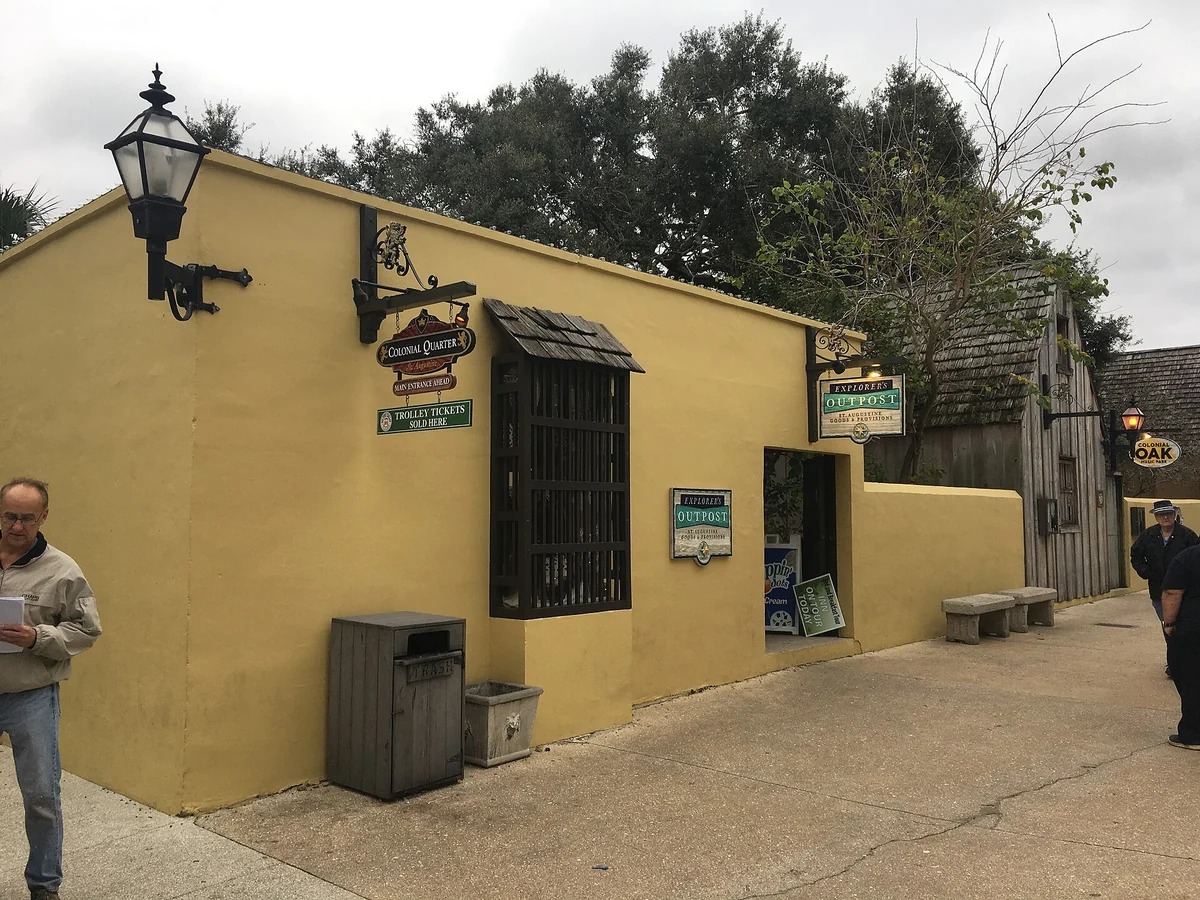
The Colonial Quarter entrance on St. George Street. Photo: LittleT889, CC BY-SA 4.0, via Wikimedia Commons
Carriage and Cart Rides Around the Street
Because St. George Street is pedestrian-only, the bookable rides travel the historic streets that surround it, and the options below are compared on this site, and the prices are the US dollar card prices only.
Horse-Drawn Carriage
The Carriage History Tour by A Legacy Carriage is a private 45-minute horse-drawn ride with a live guide, priced at $175 per carriage. It blends the city's history with family-friendly ghost tales and starts at the corner of Cathedral Place and Charlotte Street. The price covers the whole carriage.
Gratuities, food and drinks and personal expenses are not included, and free cancellation applies up to 24 hours before. A ghost-focused version, the Carriage Ghost Tour, runs the same 45 minutes at the same $175 per carriage and passes the Tolomato and Huguenot cemeteries, though entry to those cemeteries is not included.
Golf Cart and Electric Cart
The Waterfront Golf Cart Tour costs $32 per person for one hour in an open electric cart, starting at 150 Charlotte Street by the Plaza de la Constitución, with a certified guide driving and photos included. The Guided Golf Cart Tour costs $45 per person for one hour and starts on the north side of the city garage at 1 Cordova Street, which is convenient if you park there. For a private option, a 90-minute electric cart tour for up to 7 costs $200 per cart.
Carts cannot enter St. George Street itself.
The Trolley Alternative
The Hop-On Hop-Off Trolley on the Old Town Trolley costs $41 per person on this site for a 1 or 2-day ticket, with 22 stops and a full loop of 90 minutes. Its main boarding point is 167 San Marco Ave. The trolley is the right choice when you want to hop off at the Castillo de San Marcos or the Fountain of Youth rather than follow one guide.
It does not enter St. George Street either.
Sources: tour listings on this site
Do and Do Not on St. George Street
Five things worth doing and four worth skipping, each with the reason attached.
Do
- Do go on a weekday morning, because Visit St. Augustine recommends weekday mornings on St. George Street for fewer crowds.
- Do park at the garage at 1 Cordova Street, because it holds 1,200 spaces and is open 24 hours a day, 365 days a year.
- Do walk the full run from the City Gate to the Plaza, because the street follows a colonial roadbed from the 1700s and both endpoints are historic structures in their own right.
- Do use the free STAR Circulator if you park far away, because it stops at Cathedral Place between St. George and Cordova and costs nothing, funded by the Florida Department of Transportation.
- Do check hours before a paid entry, because the Peña-Peck House lists a temporary closure for tours and the Colonial Quarter's two sources give different addresses.
Don't
- Don't drive onto the street looking for a shortcut, because Visit St. Augustine describes it as pedestrian-only, so vehicles cannot use it.
- Don't rely on the $5 off-peak garage rate in the holiday season, because Visit St. Augustine says the rate does not apply during Nights of Lights and several festivals.
- Don't plan an evening around street performers, because Visit St. Augustine notes that street performers are not permitted on St. George Street.
- Don't leave your car at a meter past 9:00 p.m. unpaid, because paid enforcement runs until 9:00 p.m. seven days a week, though parking is free after that hour.
St. George Street Questions
Can you drive on St. George Street in St. Augustine?
No. Visit St. Augustine describes St. George Street as a pedestrian-only route through Historic Downtown, so cars cannot drive it. The horse-drawn carriages, golf carts and trolleys compared on this site travel the streets around it, and you can see where each one starts in the guide to where each ride starts.
What is the famous street in St. Augustine?
St. George Street is the famous one. It runs pedestrian-only from the City Gate to the Plaza de la Constitución on a colonial roadbed first laid out in the 1700s, per Visit St. Augustine. The full comparison of rides that circle it starts at the St. Augustine carriage tours homepage.
What to do on St. George Street in St. Augustine?
Walk it end to end, then visit the Oldest Wooden School House at 14 St. George Street for $6.95 per adult, the Colonial Quarter for $15.99 per adult per Florida's Historic Coast, and the free Governor's House at 48 King Street. If you would rather ride than walk, the private carriage history tour starts at Cathedral Place and Charlotte Street at $175 per carriage.
Where do I park for St. George Street?
The Historic Downtown Parking Facility at 1 Cordova Street is the closest large option, with 1,200 spaces, open 24 hours a day, at $20 per entry from 7 a.m. to 5 p.m. and $5 from 5 p.m. to 9 p.m., per the city. Meters nearby cost $2.50 per hour for visitors. The full breakdown is in the guide to St. Augustine parking.
How long does it take to walk St. George Street?
No official source gives a walking time for the street. What is stated is that the street runs from the City Gate to the Plaza de la Constitución and that weekday mornings are the quietest time, per Visit St. Augustine.
Is St. George Street busy during Nights of Lights?
Yes, and the parking price reflects it. Lights turn on daily at 5:30 p.m. and stay on past 2:00 a.m. during the festival, per Visit St. Augustine, and the $5 off-peak garage rate does not apply during Nights of Lights. If you want the lights without the crowd on foot, the Nights of Lights trolley ride shows them from a seat at $81 per private row of up to 4.